

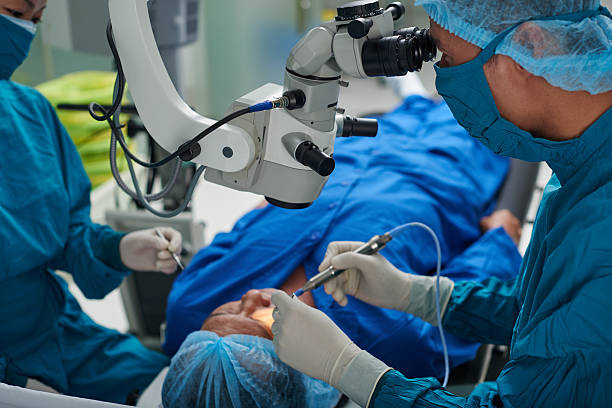
- What is a DCR (Dacryocystorhinostomy) and why is it performed?
A DCR is a surgical bypass created to restore tear drainage when the natural nasolacrimal duct is permanently blocked. Dr Grant Ladner performs this procedure at our Durban clinics to stop chronic tearing (epiphora) and prevent serious, painful infections of the lacrimal sac.
- Should I choose External or Endoscopic DCR with Dr Ladner?
Both techniques have excellent success rates, but Endoscopic DCR offers the advantage of no skin incision or visible scarring. During your consultation in Berea or Kloof, Dr Ladner will use an endoscope to examine your nasal anatomy and determine which approach offers the most reliable long-term result for your specific blockage.
- Is it normal to have a "string" or tube in my eye after DCR surgery?
Yes, a soft silicone stent (bi-canalicular tube) is standard to keep the new drainage opening from closing during the healing phase. This stent is looped between the corners of your eyelids; it is usually comfortable and will be professionally removed by Dr Ladner in our Durban rooms a few weeks later.
- Will I have a visible scar after Lacrimal surgery?
With Endoscopic DCR, there is no external scar; with External DCR, the small incision typically fades into a faint, nearly invisible line within a few months. Our surgical techniques focus on aesthetic preservation, ensuring that any external marks are placed within the natural contours of the face.
- Will I experience a black eye or swelling after the procedure?
Mild bruising and swelling around the bridge of the nose and lower eyelid are common and typically peak 48 hours after surgery. Most patients find that this "black eye" appearance fades significantly within 7 to 10 days, allowing a comfortable return to social activities.
- What are Dr Ladner’s specific post-operative restrictions?
The most critical rule is to avoid blowing your nose for at least 10 days to prevent a nosebleed or "surgical emphysema" (air under the skin). Additionally, you should avoid strenuous exercise, bending over, or lifting heavy objects for two weeks to ensure the new delicate drainage channel remains stable.
- How does Dr Ladner manage pain and bleeding during recovery?
Most patients experience a "stuffy nose" sensation rather than sharp pain, which is managed with prescribed nasal sprays and simple analgesics. While minor blood-stained spotting from the nose is normal for the first 24–48 hours, Dr Ladner’s precise surgical technique is designed to minimise the need for uncomfortable nasal packing.
- When will my watery eye symptoms actually stop?
While the blockage is bypassed immediately, your tearing may only fully resolve once the silicone stent is removed and post-surgical swelling subsides. Most patients notice a significant improvement in their comfort levels and a reduction in "sticky eye" infections within the first month.
- Why is a silicone stent (tube) placed during the surgery?
A soft silicone stent is temporarily inserted to keep the new tear drainage channel open while the internal tissues heal. This "stent" is a thin, clear tube that is usually invisible to others and is easily removed by Dr Ladner during a quick follow-up visit in Durban.
- How is the silicone stent removed, and does it hurt?
Stent removal is a quick, painless procedure performed in Dr Ladner’s consulting rooms without the need for needles or anaesthesia. The silicone is simply snipped and slid out through the nose or eye in a matter of seconds, usually between 6 and 12 weeks post-op.
- Is DCR surgery performed under general anaesthesia?
Most DCR procedures are performed under general anaesthesia to ensure patient comfort, though sedation with local anaesthesia is an option for some cases. You will typically spend a few hours in our day-clinic recovery area before being discharged home on the same day.
- How long is the recovery time after a DCR?
Most patients return to light work and normal activities within 7 to 10 days, though full internal healing takes several weeks. You should expect some mild bruising or "black eye" swelling around the nose and eyelid, which generally resolves within the first two weeks post-surgery.
- What is the success rate of DCR surgery in South Africa?
DCR surgery has a very high success rate, typically between 85% and 95% for most patients. Success depends on the underlying cause of the blockage; Dr Ladner uses high-definition endoscopic imaging to ensure the new opening is positioned for optimal long-term drainage.
Lacrimal surgery is performed to repair or reconstruct the tear duct system. The most common indication for this surgery is watering of the eye due to a blocked tear duct. In cases like these, a surgical procedure called dacryocystorhinostomy or (DCR) is performed. This is usually performed endoscopically with a camera placed in the nasal passage.